Developability—the set of biophysical and chemical properties that determine whether an antibody candidate can be successfully manufactured, formulated, and dosed—is a critical factor in clinical success. The Adimab developability toolkit, which plays an essential role in antibody selection, has been embedded in the workflow to enable early identification and elimination of high-risk candidates before costly late-stage failures occur. We describe its scientific foundation, integration into the discovery workflow, and the machine learning tools that extend its predictive power.
Approach and outcomes
- In-house analysis of 137 clinical-stage antibodies enabled the determination of developability ranges across five clusters of biophysical properties. A strong statistical correlation was observed between the number of developability flags and clinical outcome: approved molecules carried significantly fewer flags than terminated projects (p < 0.05), demonstrating that developability is a critical factor in project success.
- Adimab's developability workflow is embedded at multiple stages of antibody selection: yeast strain engineering filters out poor expressors; polyspecificity reagent (PSR) screening removes the highest polyreactive binders; experimental and machine learning-based hydrophobic interaction chromatography (HIC) screening eliminates high-hydrophobicity clones; machine learning–based de-risking of chemical liability optimizes candidates to avoid chemical liabilities; and melting temperature (Tm) and aggregation temperature (Tagg) analysis ensures robust thermal stability for formulation success.
- Evaluation of HIC and PSR screening data from the external clinical antibodies revealed a high-risk zone defined by a combination of high hydrophobicity and high polyreactivity. Among external clinical-phase molecules, comparison of external clinical-phase molecules with those from Adimab demonstrates that Adimab's developability strategy effectively biases final candidates toward low-risk profiles.
- A study of 43 IgGs with diverse biophysical properties assessed in Tg32 mice identified a strong correlation between rapid clearance and PSR, baculovirus particle (BVP), and FcRn column binding. Since there are limited options to mitigate rapid clearance once it is observed, early identification of at-risk candidates through these assays is of high value.
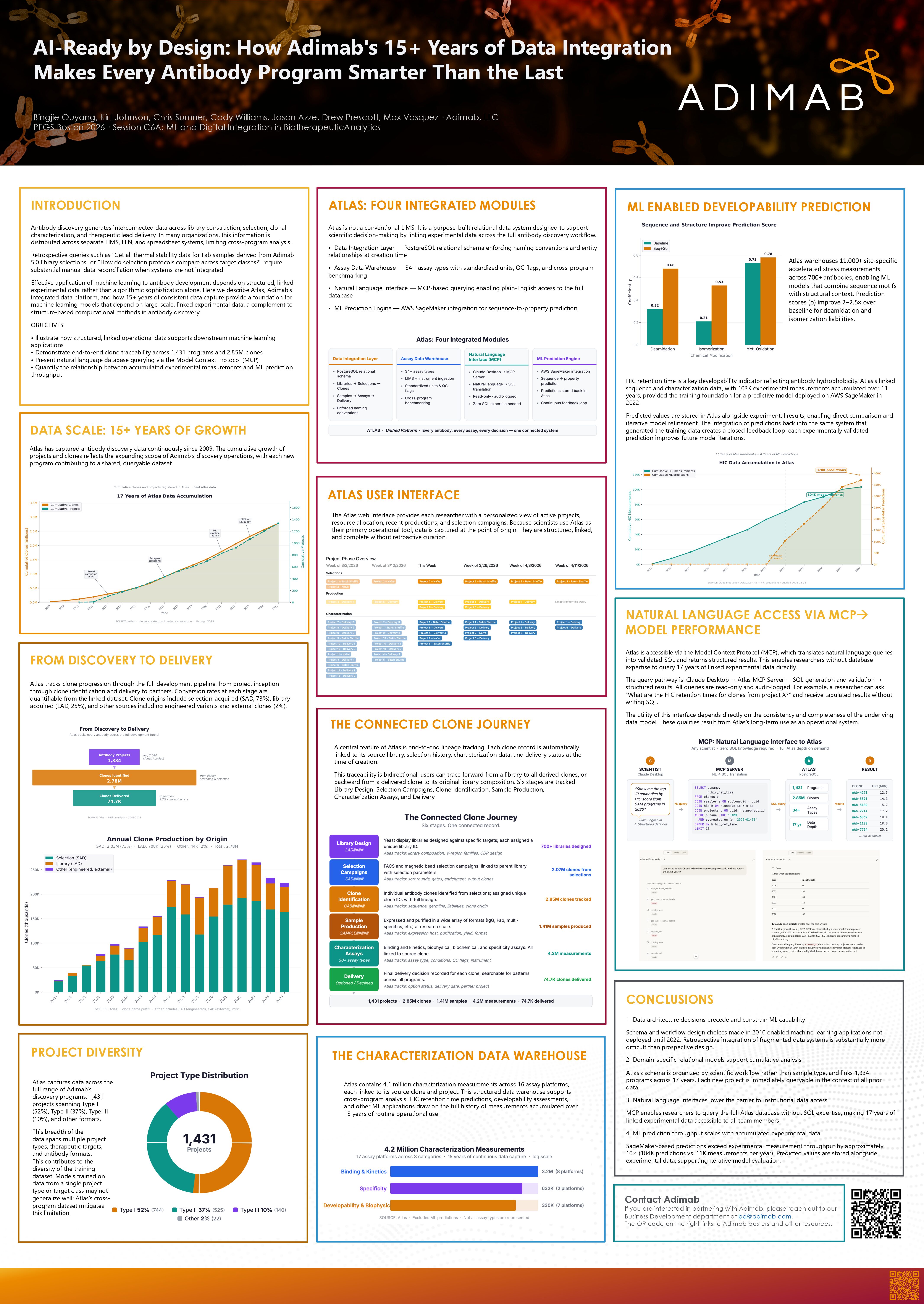
- Assessing chemical liability spanning deamidation, isomerization, and oxidation is traditionally time and resource intensive. To address this challenge, Adimab uses a database comprising over 700 antibodies with 11,000 site-specific accelerated stress data points. By combining site-specific sequence motifs with structural model information, machine learning models achieve substantially improved prediction scores for deamidation, isomerization, and methionine oxidation compared to sequence-based approaches alone, with increased prediction scores across the three chemical modification types.
Why it matters
Antibody therapeutics fail in development for many reasons, but developability risk is one of the few that can be identified and addressed early. The data support embedding a comprehensive developability panel into antibody selection from the outset. A strong statistical correlation in the number of developability flags between approved and terminated projects demonstrates that developability is a critical factor in project success. Employing a systematic, data-driven developability strategy produces candidates with more favorable risk profiles. The addition of assays which correlate to drug clearance and machine learning-based chemical liability prediction further extends the toolkit’s predictive reach, replacing low-throughput experimental methods with rapid, scalable tools without sacrificing accuracy. Together, these capabilities support the central claim that a robust developability suite embedded in early screening increases the chances of rapidly progressing a successful molecule into the clinic.
View poster