
High-purity heterodimerization without purification complexity
Generating correctly paired bispecific and multispecific antibodies (msAbs) at scale remains challenging. Traditional heterodimerization approaches either require extensive purification to remove mispaired species and homodimers or rely on mutations that compromise Fc stability and expression. Our proprietary Chain Exchange (ChEx) technology provides an efficient, data-driven solution for generating high-purity, correctly paired msAbs without purification bottlenecks.
The principle behind redox-driven heavy chain exchange
ChEx uses controlled redox conditions to temporarily dissociate heavy chains while preserving heavy–light chain pairing. Engineered CH3 interface mutations then guide selective heterodimerization, allowing efficient recombination of heavy chain pairs. This elegant approach eliminates the need for complex purification while maintaining native-like Fc function and stability.
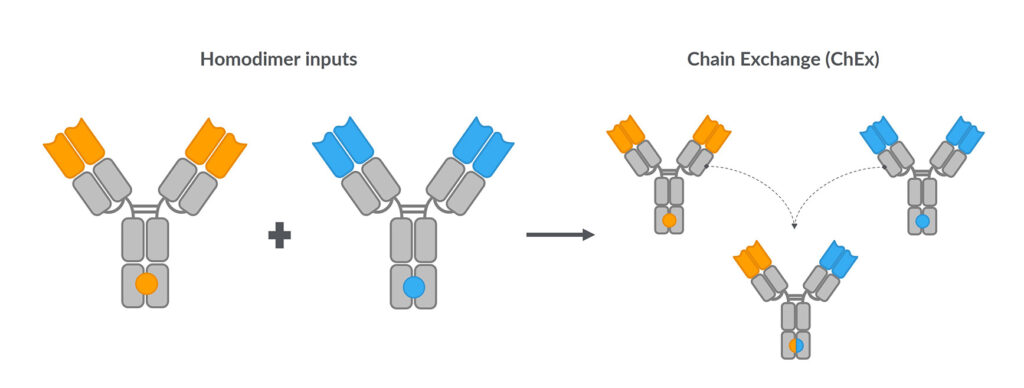
Schematic of the Chain Exchange (ChEx) process. Separate parental IgGs combine through a controlled redox step to form a defined heterodimer.
Proprietary mutations for selective pairing
Our computationally designed mutation sets enable selective heterodimerization without compromising expression yields or biophysical properties. Structural validation is performed to confirm that mutations maintain wild-type-comparable Fc stability and domain interactions, ensuring that engineered constructs perform like native antibodies in therapeutic contexts.
Analytical validation of dual-antigen engagement
Comprehensive characterization by size-exclusion chromatography (SEC), ion exchange chromatography (IEX), LC-MS, and surface plasmon resonance (SPR) confirms that ChEx-generated heterodimers are single-species products with correct chain pairing and simultaneous dual-target binding. This analytical rigor ensures that products are suitable for therapeutic advancement without unexpected assembly variants.
Results at a glance
Accelerated development pathway
Our high-throughput workflow allows generation and analytical characterization of diverse msAb architectures to identify the geometry that optimizes the identified therapeutic target, eliminating sequential iteration and format guessing.